
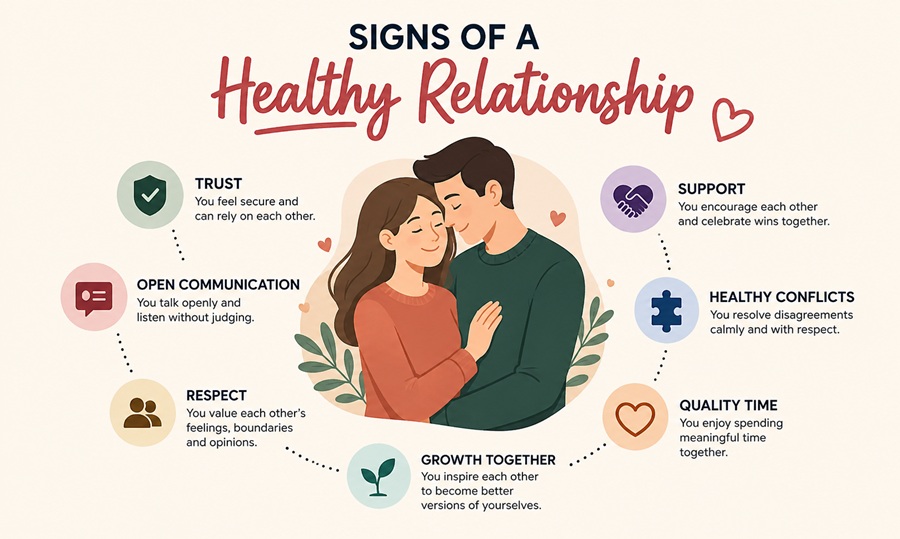
| A healthy relationship isn’t the absence of conflict, it’s how conflict gets handled, plus consistent respect, trust, and room for both people to stay their own person. Below are 12 concrete signs, grouped by category, along with what each one actually looks like day to day. |
Communication Signs
1. You can disagree without it turning into a fight
Disagreement is normal in any relationship. What matters is whether it stays focused on the actual issue or escalates into blame, sarcasm, or the silent treatment. In a healthy dynamic, a disagreement can happen and both people can walk away still feeling respected, even if nothing gets fully resolved right away.
2. You feel comfortable bringing up something that’s bothering you
If something feels off, you’re able to say so without rehearsing it for an hour or bracing for a bad reaction. That comfort usually comes from a track record, past conversations that went reasonably well, which makes the next one easier to start.
3. Apologies happen and actually mean something
A real apology acknowledges what happened rather than deflecting or minimizing it. In a healthy relationship, apologies aren’t rare or forced, and they’re usually followed by an actual change in behavior rather than the same pattern repeating a week later.
Trust and Respect Signs
4. You don’t feel the need to check up on each other
Trust shows up as an absence of something, no urge to check a phone, track a location, or need constant reassurance about where the other person is or who they’re with. That ease usually reflects consistent honesty built up over time.
5. Your boundaries are respected without a fight
Stating a limit, whether it’s about time, space, or something specific, and having it respected without guilt or pushback is one of the clearer signs of a healthy dynamic. Boundaries getting tested occasionally is normal, but they shouldn’t require a battle every time.
6. Mistakes get acknowledged instead of denied
Nobody handles everything perfectly. A healthy relationship allows room for “I got that wrong” without either person spiraling into shame or refusing to admit fault at all.
Independence Signs
7. You each maintain friendships and interests outside the relationship
A relationship that’s healthy doesn’t require either person to give up their outside life. Friendships, hobbies, and individual routines staying intact, rather than slowly disappearing, is a good sign the relationship has room for two whole people.
8. Time apart doesn’t create anxiety or guilt
Wanting to spend time together is normal. Feeling anxious, guilty, or punished for spending a weekend with friends or having a solo hobby is a different pattern, one that tends to shrink a person’s world rather than support it.
9. You support each other’s individual goals
A partner who’s genuinely glad about a promotion, a new hobby, or a goal that has nothing to do with the relationship is showing a kind of support that matters just as much as day-to-day affection.
Emotional Safety Signs
10. You feel like yourself, not a version you’re managing
In a healthy relationship, you’re not constantly adjusting your tone, opinions, or personality to avoid a bad reaction. Feeling free to be a little messy, a little off, or fully yourself without managing the other person’s mood is a strong indicator of emotional safety.
11. Difficult topics can be raised without fear of a blow up
Money, family, the future, past relationships, these topics come up eventually in any serious relationship. Being able to raise them without dreading the reaction is a sign the relationship can hold real conversations, not just easy ones.
12. You generally feel more energized than drained after time together
This one is simple but telling. Relationships have hard days, but on balance, time spent together should leave you feeling more like yourself, not consistently smaller, more anxious, or more exhausted.
Healthy vs. Unhealthy Patterns at a Glance
| Healthy Pattern | Unhealthy Pattern |
| Disagreements stay focused on the issue | Disagreements turn into blame or silent treatment |
| Boundaries are respected without a fight | Boundaries are met with guilt or pushback |
| Outside friendships stay intact | Outside relationships slowly shrink |
| Mistakes are acknowledged and addressed | Mistakes are denied or minimized |
| You feel like yourself around your partner | You’re managing your tone or mood constantly |
| WATCH FOR THIS
A rough patch or a bad week doesn’t automatically mean a relationship is unhealthy. What matters is whether these signs hold up as a general pattern over time, not whether every single day looks perfect. |
Why These Signs Matter More Together Than Alone
No single sign on this list makes or breaks a relationship. A couple could have great communication but be working on independence, or strong trust but still be learning how to fight fairly. What matters more is the overall pattern, whether most of these signs are generally present and whether the relationship is moving toward more of them over time rather than fewer.
It’s also worth remembering that these signs look different depending on the couple. Some relationships are naturally more talkative, others more low-key, and healthy doesn’t have to mean identical to someone else’s relationship. The consistent thread across healthy relationships isn’t a specific style, it’s mutual respect, honesty, and both people generally feeling safe being themselves.
What to Do If Some of These Are Missing
- Bring up the specific pattern directly rather than a vague complaint, and see how the conversation goes
- Give it real time and attention rather than assuming nothing can change
- Notice whether effort is mutual, since a healthy relationship shouldn’t rest on one person doing all the adjusting
- Consider talking to a couples counselor if the same pattern keeps repeating despite good-faith conversations
The Bigger Picture
These signs are a useful checkpoint, not a scorecard. A relationship can be healthy and still have areas that need work, since no couple gets everything right all the time. What separates a healthy relationship from an unhealthy one usually isn’t perfection, it’s whether both people are willing to notice when something’s off and actually address it together, rather than letting the same pattern quietly repeat.
Frequently Asked Questions
Does a healthy relationship mean you never fight: No. Disagreement is normal in any relationship. What matters is how the disagreement is handled, whether it stays respectful and gets resolved, rather than whether it happens at all.
How many of these signs need to be present for a relationship to be healthy: There’s no strict number, but a relationship missing several of these consistently is worth a closer, honest look rather than being written off as normal ups and downs.
Can a relationship become healthier over time: Yes. Many relationships improve with direct communication, consistent effort from both people, and sometimes outside support like couples counseling.
What’s the difference between a rough patch and an unhealthy pattern: A rough patch is temporary and tied to a specific stressor. An unhealthy pattern repeats regardless of circumstances and tends to get minimized or denied when it’s brought up.
Is wanting a lot of alone time a sign of an unhealthy relationship: Not on its own. Healthy relationships generally allow room for independence and outside interests, as long as it isn’t being used to avoid the relationship altogether.