
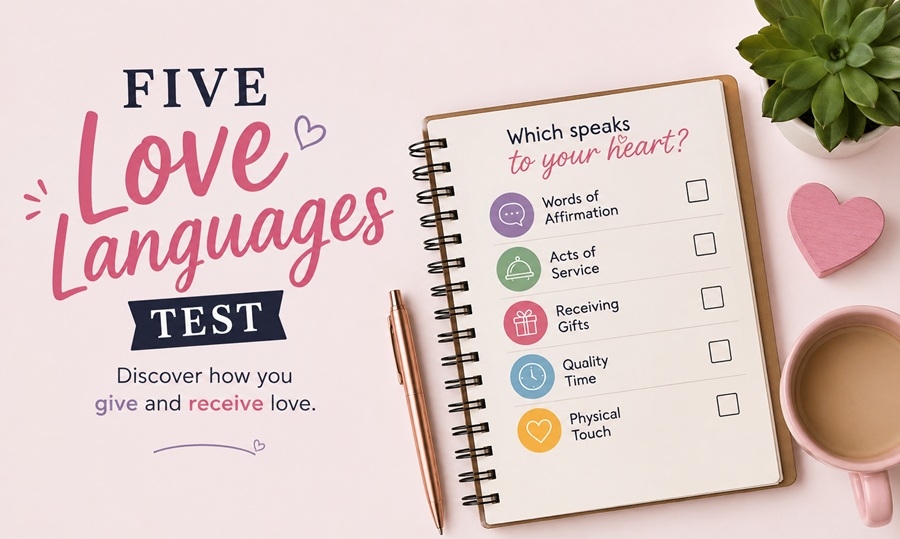
You don’t need an official quiz to figure out your love language. Paying attention to how you naturally express affection, what you complain about most in relationships, and what makes you feel most appreciated will usually point clearly to one or two of the five languages: words of affirmation, quality time, receiving gifts, acts of service, and physical touch.
Here’s a practical way to work through it step by step, along with how to interpret what you notice.
Step 1: Look at How You Naturally Show Love
The way you express affection is often a strong clue to your own love language, since people tend to give what they most want to receive.
Ask yourself which of these feels most natural to you:
- Do you frequently tell people how much they mean to you, or write thoughtful messages?
- Do you prioritize spending focused, distraction-free time with people you care about?
- Do you enjoy picking out gifts and thinking about what someone specifically would like?
- Do you show care by doing things for people, like helping with tasks or errands?
- Do you gravitate toward hugs, physical closeness, or sitting near people you love?
Whichever one you do most instinctively, without thinking about it, is often a strong indicator of your primary language.
Step 2: Identify What You Complain About Most
Frustration in relationships is often a mirror of unmet needs. Think back to past relationships or friendships and consider what bothered you the most.
- If a lack of verbal appreciation stung the most, words of affirmation may be your language
- If feeling ignored or distracted during time together bothered you more than anything else, quality time likely matters most
- If forgotten occasions or thoughtless gestures felt especially hurtful, receiving gifts may be significant for you
- If a partner’s unwillingness to help with practical things frustrated you repeatedly, acts of service is likely important
- If a lack of physical affection left you feeling disconnected, physical touch may be your primary language
Step 3: Notice What Makes You Feel Most Appreciated Right Now
Think of a recent moment when you felt genuinely cared for. What specifically happened?
- Was it something someone said to you?
- Was it uninterrupted time spent together?
- Was it a thoughtful item or note?
- Was it someone doing something helpful without being asked?
- Was it a hug, hand on your shoulder, or physical closeness?
The category that comes to mind fastest is usually a reliable signal, since people tend to remember moments tied to their primary language more vividly than others.
Step 4: Rank the Five Languages for Yourself
Once you’ve gone through the steps above, try ranking all five from most to least important to you personally. Most people find one or two languages clearly stand out, while the remaining three feel noticeably less essential, even if they’re still appreciated.
This ranking is more useful than trying to pick a single answer, since most people value more than one language to some degree.
Step 5: Compare Notes With a Partner
If you’re doing this with a partner, both of you should go through the same process separately before comparing results. This avoids one person’s answers influencing the other’s, and it often reveals mismatches that explain recurring friction, like one partner expressing love through acts of service while the other has been waiting to hear it in words.
What to Do With Your Results
Knowing your love language is only useful if it changes behavior. Once you and a partner know each other’s languages, the most effective next step is intentionally incorporating the other person’s language into daily interactions, even if it doesn’t come naturally at first.
Practical starting points:
- If their language is words of affirmation, build in specific, genuine verbal appreciation regularly
- If it’s quality time, protect small blocks of distraction-free time together
- If it’s receiving gifts, keep a mental note of things they mention wanting or liking
- If it’s acts of service, look for small tasks you can take off their plate
- If it’s physical touch, increase small, casual physical affection throughout the day
A Note on Formal Online Quizzes
Formal quizzes exist and can be a useful starting point, especially for people who find it hard to self-reflect without structured questions. That said, the self-assessment steps above tend to produce similarly accurate results, since they’re based on the same underlying signals a formal quiz asks about, just applied to your own specific history and patterns.
Frequently Asked Questions
Is it possible to have all five love languages equally?
It’s uncommon but possible. Most people find one or two languages stand out clearly once they reflect on their patterns, even if all five matter to some extent.
Should I take the test alone or with my partner?
Both. Completing it separately first, then comparing results together, tends to produce more honest answers than doing it side by side.
Can my love language be different from how I express love to others?
Yes. Some people express love in one language but prefer to receive it in another, which is worth noting separately.
How often should I revisit my love language?
It’s worth reconsidering during major life changes, like a new relationship stage, a stressful period, or after having children, since needs can shift over time.
Does knowing my love language fix relationship problems on its own?
No. It’s a useful communication tool, not a complete solution. It works best combined with open conversation and consistent effort from both partners.