
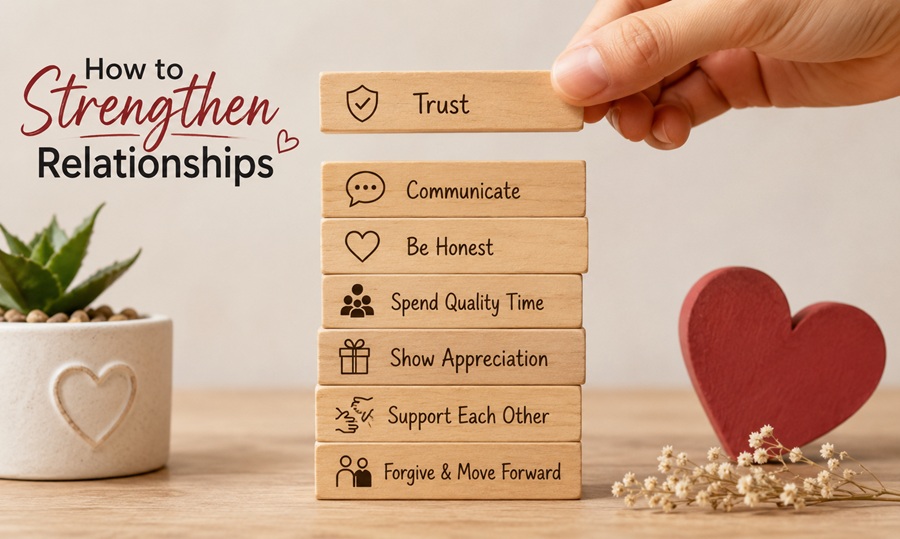
Every long-term couple hits a point where the relationship needs active maintenance rather than passive momentum. That’s not a bad sign — it’s just what happens once the initial rush of new love settles into daily life. The couples who stay close aren’t the ones who never struggle; they’re the ones who’ve built specific habits that keep the connection strong even when life gets busy. Here are 12 of them, drawn from relationship research and therapist-recommended practices.
1. Build a Daily Check-In Habit
Even five minutes of undistracted conversation about how each of you is actually doing — not logistics, not schedules — keeps you emotionally in sync. Couples who let weeks pass without a real conversation often find that small misunderstandings snowball simply because there was no regular space to address them. Try tying the check-in to an existing routine, like right after dinner or during a shared commute, so it happens consistently rather than only when things feel urgent.
2. Protect Regular One-on-One Time
Quality time gets crowded out by work, kids, and screens faster than most couples realize. Scheduling it — even something as simple as a weekly walk without phones — signals that the relationship is a priority, not an afterthought. The activity itself matters far less than the undivided attention; a 20-minute walk with full presence often does more for connection than a three-hour outing spent half-distracted.
3. Learn Each Other’s Stress Signals
Knowing how your partner behaves when they’re overwhelmed (do they withdraw, get short-tempered, go quiet?) helps you respond with patience instead of taking it personally. This single skill prevents a huge share of avoidable arguments, since so many fights start not from the original issue but from one partner misreading the other’s stress response as anger or disinterest directed at them.
4. Fight Fair
Conflict itself isn’t what damages relationships — how it’s handled is. Research from the Gottman Institute has repeatedly found that criticism, contempt, defensiveness, and stonewalling (the ‘Four Horsemen’) are the strongest predictors of relationship breakdown.
Rules for Fair Fighting
- Address the specific issue, not your partner’s character
- Take breaks if either of you feels flooded or overwhelmed
- Avoid bringing up unrelated past grievances mid-argument
- Aim to understand before trying to be understood
- End disagreements with repair, even if it’s small (a hand on the shoulder, an ‘I love you’)
5. Keep Physical Affection Alive
Non-sexual touch — hugs, hand-holding, a hand on the back while passing in the kitchen — releases oxytocin and reinforces a sense of safety. Couples who maintain casual physical affection tend to report higher relationship satisfaction than those who only touch during sex, since it keeps a baseline of warmth present throughout the ordinary, non-romantic parts of the day.
6. Say Thank You for the Small Things
Gratitude isn’t just for holidays. Acknowledging the small, unglamorous things your partner does — making coffee, handling a phone call you dreaded, remembering something you mentioned once — keeps appreciation active instead of assumed. Left unacknowledged long enough, these small contributions tend to breed quiet resentment on one side and a sense of being taken for granted on the other.
7. Keep Learning About Each Other
People change. The partner you fell for five years ago has new fears, new interests, and new goals. Staying curious rather than assuming you already know everything keeps the relationship from going stale, and it’s often as simple as asking open-ended questions periodically instead of relying on old assumptions about what your partner wants or believes.
8. Handle Money Conversations Early and Often
Financial stress is one of the most common relationship strain points. Talking about money regularly, rather than only during a crisis, reduces resentment and builds a shared sense of teamwork. Even a short monthly check-in about spending, savings goals, or upcoming expenses can prevent the kind of blindside conflict that often erodes trust.
9. Support Each Other’s Individual Lives
Strong couples don’t merge into one identity — they stay two whole people who choose each other. Encouraging friendships, hobbies, and goals outside the relationship actually strengthens the bond rather than threatening it, since each partner returns to the relationship with more to bring, rather than depleting a single shared identity.
10. Reintroduce Novelty
New, shared experiences — trying a new restaurant, taking a class together, traveling somewhere neither of you has been — reactivate some of the same dopamine response associated with early attraction. Novelty doesn’t need to be expensive or elaborate; even small deviations from routine, like taking a different route on a weekend walk, can produce a similar effect.
11. Apologize Without ‘But’
A real apology takes ownership without immediately following it with a justification. ‘I’m sorry I snapped at you, but I was stressed’ undercuts the apology. ‘I’m sorry I snapped at you’ lands as sincere. If context is genuinely important to share, it usually lands better as a separate conversation once the apology itself has been fully received.
12. Revisit Your Shared Vision
Couples who periodically talk about where they’re headed — together — tend to stay more aligned than those who let big-picture conversations lapse for years at a time. An annual conversation about goals, priorities, and any shifts in what each of you wants can catch misalignment early, before it hardens into resentment.
| Habit | Time Investment | Impact |
| Daily check-in | 5–10 minutes | Prevents small issues from building up |
| Weekly one-on-one time | 1–2 hours | Maintains emotional closeness |
| Physical affection | Ongoing, casual | Builds daily sense of safety and connection |
| Shared vision talks | Quarterly | Keeps long-term goals aligned |
Starting Small: Where to Begin
Trying to implement all twelve habits at once usually backfires — it starts to feel like homework rather than genuine connection. A more sustainable approach is choosing two or three that feel most relevant to your relationship’s current gap, practicing them consistently for a month, and then layering in more once they’ve become natural rather than effortful. Relationships strengthen through repetition, not intensity, so consistency matters more than doing everything perfectly from day one.
When One Partner Is More Invested Than the Other
It’s common for one partner to feel more motivated to actively work on the relationship than the other, at least initially. Rather than framing this as a fundamental incompatibility, it’s often more productive to bring specific, small requests rather than a vague ask to ‘try harder.’ Asking for one concrete change — a ten-minute daily check-in, a weekly walk together — tends to get more traction than a broader conversation about needing more effort overall, which can feel overwhelming or accusatory to the less-engaged partner.
That said, a persistent, significant gap in investment over time is worth naming directly and, if needed, addressing with the support of a couples therapist, since one partner consistently carrying more of the relationship’s emotional labor tends to breed resentment regardless of how the imbalance started.
How to Know If the Relationship Needs More Than Habit Changes
These twelve habits work well for relationships facing ordinary drift — the kind of disconnection that comes from busy schedules and competing priorities rather than deeper incompatibility or unresolved harm. If a relationship is struggling with more serious issues — repeated broken trust, unresolved resentment from a significant betrayal, or a persistent pattern of disrespect — habit-building alone is unlikely to be sufficient. In those cases, working with a licensed couples therapist gives both partners a structured, guided space to address root issues that daily habits can support but not fully resolve on their own.
Frequently Asked Questions
How often should couples have deep conversations to stay connected?
Most therapists recommend at least a short daily check-in, plus a longer, undistracted conversation weekly to maintain emotional closeness.
Can a relationship be strengthened after a big betrayal?
Yes, though it typically requires consistent transparency, patience, and often professional support like couples counseling to rebuild trust over time.
What’s the biggest relationship strengthening habit according to research?
Consistent, respectful communication — particularly how couples handle conflict — is one of the strongest predictors of long-term relationship satisfaction in relationship research.
Is date night really necessary for long-term couples?
Scheduled quality time isn’t strictly required, but couples who protect it tend to report significantly higher satisfaction than those who let it lapse indefinitely.
How do you strengthen a relationship when partners have different love languages?
Start by learning and explicitly discussing each other’s preferences, then intentionally practice expressing affection in the way your partner receives it best, not just the way feels natural to you.
Conclusion
None of these twelve habits are complicated on their own — that’s the point. Strengthening a relationship rarely comes down to one dramatic gesture; it comes down to small, repeated choices that add up over months and years. Pick two or three from this list that feel most relevant to where you and your partner are right now, and start there.