
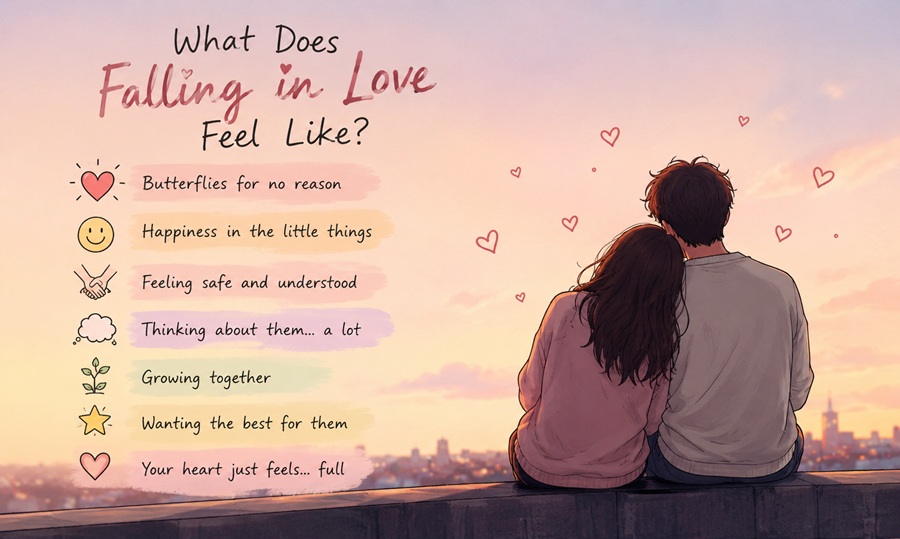
| Quick Answer
Falling in love feels like a mix of excitement, nervousness, and preoccupation — a racing heart around the person, constant thoughts about them, and a heightened sense of optimism. It’s driven by real neurochemical shifts (dopamine, norepinephrine, and later oxytocin) and typically moves through distinct stages over weeks to months. |
There’s a moment — maybe it’s a text notification that makes your stomach flip, or a conversation that runs three hours longer than planned — when you realize something has shifted. You’re not just interested in this person anymore. You’re falling. And if you’ve never quite been able to put words to that feeling, or you’re trying to figure out whether what you’re experiencing is real, you’re not alone. It’s one of the most searched, least precisely described feelings in the human experience.
The Physical Sensations
Before it’s a thought, falling in love is a body experience. Most people report some combination of the following in early romantic attraction:
- A racing or fluttering heartbeat when the person is near or even just texts
- Butterflies or a knot in the stomach before seeing them
- Sweaty palms or slight nervousness during conversation
- Trouble sleeping because your mind keeps replaying the day
- A surge of energy or restlessness, almost like mild anxiety
- Loss of appetite, or conversely, everything tasting better
These sensations trace back to real biology. Early attraction activates the sympathetic nervous system, the same system responsible for a fight-or-flight response, which is part of why new love can feel thrilling and slightly destabilizing at the same time.
The Emotional and Mental Shifts
Alongside the physical symptoms, something changes mentally. Researchers who study romantic love, including biological anthropologist Helen Fisher, have found that early-stage love resembles a mild obsession. You think about the person far more than seems reasonable. Their flaws blur. Ordinary songs, streets, or smells start to remind you of them.
Common Emotional Signs
- Intrusive, frequent thoughts about the person throughout the day
- A strong desire to know everything about their life and history
- Heightened optimism — the future suddenly feels brighter
- Increased sensitivity to their mood or approval
- A willingness to overlook minor annoyances or red flags
- Feeling both euphoric and slightly anxious, sometimes within the same hour
The Stages of Falling in Love
Falling in love isn’t a single event — it typically unfolds in overlapping stages, each with a different emotional texture.
Stage 1: Attraction and Infatuation
This is the dopamine-driven phase most people associate with ‘falling.’ It’s intense, a little irrational, and usually lasts anywhere from a few weeks to several months. Everything about the person feels novel and slightly larger than life.
Stage 2: Building Trust
As the initial intensity settles, couples begin testing whether the connection holds up outside of the honeymoon glow — during disagreements, stress, or ordinary daily life. This stage is where compatibility actually starts to reveal itself.
Stage 3: Attachment and Bonding
Oxytocin and vasopressin, sometimes called the ‘bonding hormones,’ become more dominant here. The relationship starts to feel less like a thrill ride and more like a stable, secure base — which is its own kind of falling, just quieter.
| Stage | Typical Duration | Dominant Feeling |
| Attraction / Infatuation | 2 weeks – 6 months | Euphoria, obsession, nervous energy |
| Building Trust | 3 – 12 months | Curiosity, occasional doubt, deepening comfort |
| Attachment / Bonding | Ongoing | Security, calm, deep affection |
How to Tell If It’s Real Love or Infatuation
Infatuation and love can feel identical in the first few weeks, which is exactly why people ask this question so often. A few distinguishing signs of the real thing tend to show up over time, not in the first rush of feeling.
- Your feelings hold up even after seeing the person on a bad, unglamorous day
- You genuinely want good things for them, separate from what you get out of it
- The relationship adds stability to your life rather than constant chaos
- You can disagree with them without the whole connection feeling threatened
- Your interest in their life extends beyond physical or romantic attraction
| Note: It’s completely normal for the intense, butterflies-heavy stage to fade. That fading isn’t a sign love is dying — it’s usually a sign the relationship is moving into a steadier, more attachment-based phase. |
The Neuroscience Behind the Feeling
Brain imaging studies of people newly in love show activation in regions associated with reward and motivation — the same areas that light up in response to addictive substances, which is part of why new love can feel genuinely compulsive. Dopamine drives the craving and pleasure response, norepinephrine contributes to the racing heart and heightened alertness, and serotonin levels actually tend to drop during intense infatuation, which some researchers believe contributes to the obsessive, intrusive-thought quality of early love.
As the relationship matures, this neurochemical profile shifts. Oxytocin, released during physical touch and closeness, and vasopressin, associated with long-term pair bonding, become more central. This shift is why long-term partners often describe their feelings as calmer and steadier rather than any less real — the underlying biology has simply moved from short-term craving to long-term attachment.
Why Falling in Love Can Feel Different Each Time
People frequently notice that falling in love feels different in their twenties compared to later in life, or different with a second serious partner compared to their first. Past relationship experience, attachment style, and even unresolved patterns from previous heartbreak all shape how the brain and body respond to new attraction. Someone with an anxious attachment style, for instance, may experience the early stages with more intensity and preoccupation, while someone with a more secure attachment style may notice the same excitement without as much accompanying anxiety.
When the Feeling Doesn’t Match the Relationship
It’s worth naming directly: the intensity of falling-in-love feelings doesn’t always correlate with relationship health. Some of the most intense, all-consuming infatuations occur in relationships with poor long-term compatibility, precisely because novelty and uncertainty amplify the dopamine response. Conversely, a relationship that grows more slowly and steadily isn’t necessarily less significant — it may simply be building attachment through a different, less dramatic pathway. Paying attention to how a partner treats you consistently, rather than solely how intensely you feel around them, is a more reliable gauge of whether the relationship is actually good for you.
Cultural and Individual Differences in Describing the Feeling
Not everyone describes falling in love the same way, and that variation is worth normalizing rather than treating as a red flag. Some people experience it primarily as physical sensation, others as a mental preoccupation with few physical symptoms at all, and still others describe it more as a growing sense of comfort and rightness than any dramatic rush. Cultural background, past relationship experiences, and even personality traits like general emotional expressiveness all shape how the experience gets described. Two people can both genuinely be falling in love while describing it in almost entirely different terms.
What to Do With the Feeling Once You Recognize It
Recognizing that you’re falling for someone naturally raises the question of what to do next. For most people, the healthiest approach is neither suppressing the feeling out of fear nor acting entirely on impulse, but rather letting the feeling inform — without fully dictating — your decisions. Share how you’re feeling when it feels appropriate and safe to do so, continue paying attention to how the relationship holds up under ordinary, non-romantic circumstances, and give the connection time to reveal whether the underlying compatibility matches the emotional intensity.
How Falling in Love Differs From Staying in Love
One of the more useful distinctions relationship researchers draw is between falling in love and staying in love — two related but distinct processes with different underlying mechanics. Falling in love is largely involuntary, driven by novelty and biochemistry that naturally intensifies and then fades. Staying in love, by contrast, is far more a matter of choice and habit: continuing to prioritize the relationship, choosing curiosity over assumption, and actively maintaining closeness once the automatic rush has settled. Couples who understand this distinction tend to weather the natural fading of early intensity with less anxiety, because they know it’s not a sign the relationship is failing — it’s simply the handoff from one phase to the next.
Frequently Asked Questions
How long does the falling in love feeling usually last?
The intense, euphoric phase typically lasts a few months up to about two years, driven largely by dopamine and norepinephrine, before settling into calmer, oxytocin-driven attachment.
Is it normal to feel anxious when falling in love?
Yes. Early romantic attraction activates the same stress-response system as anxiety, which is why nervous excitement is such a common description of new love.
Can you fall in love without physical symptoms?
Some people experience falling in love more mentally than physically, especially in relationships that build slowly from friendship. Intensity of physical symptoms varies a lot person to person.
What’s the difference between falling in love and lust?
Lust is driven primarily by testosterone and estrogen and centers on physical attraction, while falling in love involves broader emotional investment, curiosity about the person’s life, and a desire for closeness beyond the physical.
Why does falling in love feel different the second or third time?
Past relationship experience changes how your brain processes new attraction, often making later experiences feel less all-consuming but more grounded and self-aware.
Falling in love rarely feels the way movies describe it — cinematic and clean. It’s messier: equal parts giddy and unsettling, thrilling and a little disorienting. If what you’re feeling includes racing thoughts, nervous energy, and a pull toward someone you can’t quite explain, you’re likely right in the middle of it. Whether it turns into lasting love depends less on how intense that feeling is and more on what happens once it starts to settle.