
| QUICK ANSWER
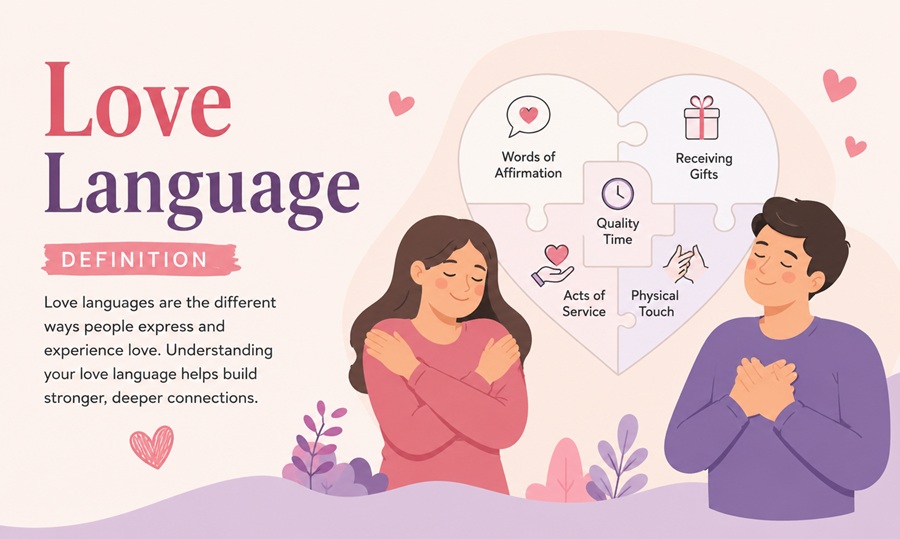
A love language is the specific way a person prefers to give and receive love — through words, time, gifts, acts of service, or touch. The concept, introduced by Dr. Gary Chapman in 1992, explains why sincere affection sometimes fails to land: partners may be expressing love in a way the other doesn’t recognize as love. |
Picture a couple where one partner spends an entire Saturday cooking a favorite meal, tidying the apartment, and running errands so the other can rest — clear, practical devotion. The other partner appreciates it, but what they actually needed that day was ten uninterrupted minutes of conversation, a check-in, some undivided attention. Neither partner did anything wrong. They were simply speaking different dialects of the same underlying feeling, and that mismatch is exactly what the love language framework was built to explain.
Dr. Chapman developed the idea after years of marriage counseling, noticing a recurring pattern: couples in distress weren’t usually short on love, they were short on translation. He identified five recurring categories people use to express and interpret affection, and the framework spread far beyond couples’ therapy into friendships, parenting, and workplace relationships because the underlying insight is so broadly applicable — people don’t all feel cared for in the same way.
The five love languages are words of affirmation, quality time, receiving gifts, acts of service, and physical touch. Words of affirmation covers verbal encouragement, compliments, and expressions of appreciation — for someone with this as a primary language, hearing ‘I’m proud of you’ can matter more than any gesture. Quality time means focused, undistracted presence; for this person, a partner glued to their phone during dinner registers as genuine neglect, regardless of intention. Receiving gifts isn’t about materialism — it’s about the thoughtfulness a gift represents, proof that someone was thinking of you when you weren’t there. Acts of service covers the practical, sometimes unglamorous things people do for each other, from cooking dinner to fixing a leaking faucet, framed as love expressed through effort. Physical touch includes everything from holding hands to a supportive hand on the shoulder, and for someone with this as their primary language, physical distance can feel like emotional distance even when nothing else has changed.
Understanding your own love language starts with noticing what you complain about and what you crave. People often express hurt in the language they most need — someone who says ‘you never help around here’ may be signaling an acts-of-service need, while someone who says ‘you never say anything nice to me’ is often craving words of affirmation. The reverse is also revealing: think about what you naturally do for people you love. Many people default to giving affection in their own primary language, which is exactly why mismatches happen so easily — you’re fluent in a dialect your partner never learned to hear.
The framework isn’t a rigid science, and critics point out that most people value a blend of languages rather than a single dominant one, and that relationship satisfaction depends on far more than matching languages — trust, conflict resolution, and shared values matter enormously too. Even so, as a conversation-starter and a shorthand for expressing needs, it remains genuinely useful. Telling a partner ‘I feel most loved when we get uninterrupted time together’ is a concrete, actionable request in a way that ‘be more loving’ never could be.
How to Actually Use This With a Partner
Rather than treating the five languages as a rigid label, use them as a starting point for a specific conversation: ask each other what makes you feel most cared for on an ordinary Tuesday, not just on anniversaries. Notice which language you default to giving and check whether it matches what your partner actually needs. Small, consistent adjustments — a five-minute check-in, a handwritten note, an unprompted errand run — tend to matter more than grand, occasional gestures, because they build a pattern your partner can rely on.
FAQs
Q: Who created the love languages concept?
Dr. Gary Chapman, a marriage counselor, introduced the framework in his 1992 book ‘The 5 Love Languages,’ based on patterns he observed in decades of couples counseling.
Q: Can a person have more than one love language?
Yes. Most people resonate with two or three languages rather than a single exclusive one, though many still have a clear top preference.
Q: Is there scientific evidence behind love languages?
Research on the framework is mixed — some studies question whether matching languages predicts relationship satisfaction, though the concept remains widely used as a practical communication tool.
Q: Can love languages change over time?
Yes, life stages like new parenthood, illness, or high-stress periods can shift what someone needs most from a partner, even temporarily.
Q: How do I find my love language?
Reflect on what hurts most when it’s missing and what you naturally do for people you love — both tend to point toward your primary language.