
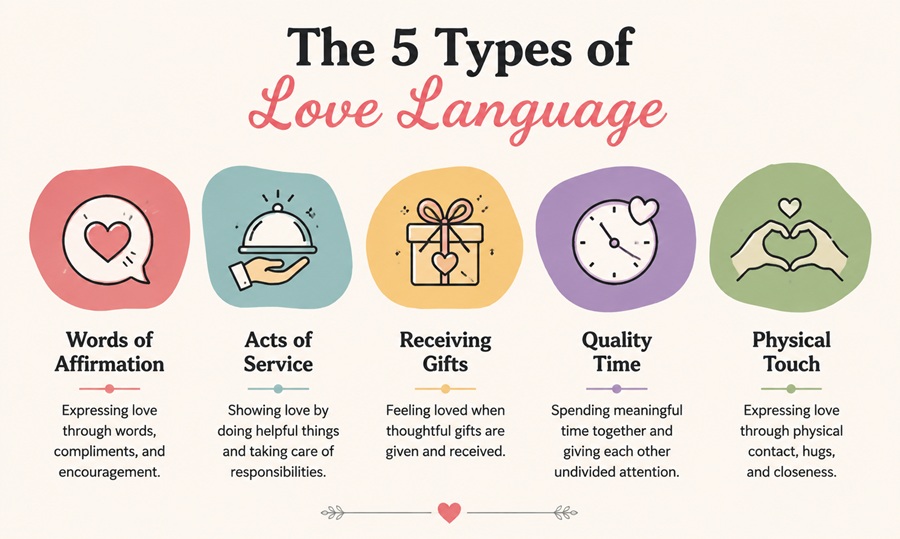
The five love languages framework, developed by counselor Gary Chapman, sorts the ways people give and receive love into five broad categories. Knowing yours — and your partner’s — can explain a surprising amount of relationship friction that otherwise looks like mismatched effort.
The five love languages are Words of Affirmation, Quality Time, Acts of Service, Physical Touch, and Receiving Gifts. Most people have one or two dominant languages, and mismatches between partners’ languages — not a lack of love — are often behind the feeling that effort isn’t being noticed.
Words of Affirmation
For people with this as a primary language, verbal acknowledgment — compliments, encouragement, a simple “I appreciate you” — carries more weight than almost anything else. Criticism or silence tends to land harder for these individuals than it might for others.
Example in practice: A partner leaving a note before work, or texting “I’m proud of how you handled that today.”
Quality Time
This is about focused, undivided attention rather than simply being in the same room. Someone with this as a primary language often feels most loved during a conversation with phones away, or a shared activity done together without distraction.
Example in practice: A weekly no-phones dinner, or a partner turning off the TV specifically to talk.
Acts of Service
Here, actions speak louder than words — literally. Doing something helpful, like handling a chore your partner dreads or running an errand without being asked, registers as love more strongly than verbal compliments would.
Example in practice: Filling up the car with gas before a partner needs to ask, or making coffee before they wake up.
Physical Touch
Beyond a romantic or sexual context, this language includes small physical gestures — a hand on the shoulder, sitting close together, a hug after a hard day. For people with this as a dominant language, physical distance can feel like emotional distance too.
Example in practice: Holding hands during a walk, or a hug offered without needing to be asked.
Receiving Gifts
Often misunderstood as materialistic, this language is really about thoughtfulness made visible — a small item that shows someone was paying attention, more than the monetary value of the gift itself.
Example in practice: Bringing home a partner’s favorite snack after a long day, unprompted.
How to Identify Your Own Language
A simple test: think back to what hurt most in a past conflict. If forgotten plans stung more than harsh words, quality time might rank high for you. If an unhelpful partner during a busy week bothered you more than a lack of compliments, acts of service might be your primary language.
A Comparison Table
| Love Language | What It Values Most | Common Misread |
|---|---|---|
| Words of Affirmation | Verbal appreciation | Mistaken for needing constant praise |
| Quality Time | Undivided attention | Mistaken for being needy |
| Acts of Service | Helpful action | Mistaken for expecting a “servant” |
| Physical Touch | Physical closeness | Mistaken as purely sexual |
| Receiving Gifts | Thoughtful gestures | Mistaken for materialism |
Using This in a Real Relationship
The most common friction point is a mismatch — one partner showing love through acts of service while the other primarily needs words of affirmation, leading both to feel unappreciated despite genuine effort on both sides. The fix usually isn’t abandoning your own natural language, but learning to occasionally speak your partner’s, even if it doesn’t come naturally at first.
Frequently Asked Questions
Can someone have more than one primary love language?
Yes, many people rank two languages closely, rather than having a single dominant one.
Do love languages change over time?
They can shift, particularly during major life changes like having children or going through a stressful period.
Is this framework scientifically proven?
It’s more of a popular, practical framework than a rigorously validated psychological theory, though many couples find it useful as a communication shorthand regardless.
What if my partner and I have completely different love languages?
That’s common, not a red flag — it just means both partners benefit from learning to express love in the other’s preferred language occasionally.
How do I bring this up with my partner without it feeling forced?
Framing it as curiosity — “what actually makes you feel most loved day to day” — tends to open the conversation naturally.
Knowing your love language doesn’t fix every relationship issue, but it does explain a lot of the “I know they love me, but why doesn’t it feel that way” confusion that couples run into — often just a mismatch in the language being spoken.