
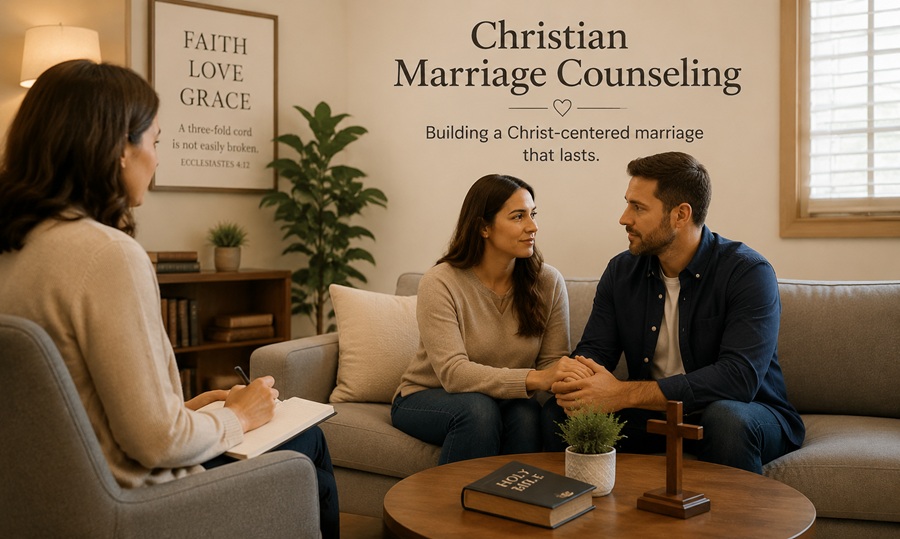
For couples who want their faith actively woven into the counseling process rather than set aside, Christian marriage counseling offers an approach built specifically around that goal.
Quick Answer: Christian marriage counseling combines standard evidence-based couples therapy techniques with a faith-centered framework — prayer, scripture, and biblical principles around commitment and forgiveness — typically provided by a licensed counselor with specific training in integrating faith and clinical practice.
How It Differs From Standard Couples Therapy
Step One: Shared Foundation Both use core therapeutic tools — active listening exercises, conflict resolution frameworks, communication techniques grounded in research.
Step Two: The Added Layer Christian counseling layers in prayer during or around sessions, scripture as a reference point for discussing commitment, forgiveness, and roles within the marriage, and often frames the relationship itself within a broader faith context rather than purely as a private partnership between two individuals.
Step Three: Counselor Qualifications The best Christian marriage counselors hold the same clinical licensing as secular therapists (LMFT, LPC, or similar) in addition to specific training in pastoral or faith-integrated counseling — worth confirming directly rather than assuming.
What a Typical Session Looks Like
- An opening check-in, sometimes including prayer, on how the week has gone
- Discussion of a specific recurring conflict or challenge, using structured communication tools
- Scripture or faith-based framing applied to the specific issue at hand
- Practical exercises or “homework” to practice between sessions
- A closing prayer or reflection, in many but not all practices
Common Topics Covered
- Communication and conflict resolution, often framed around biblical concepts of humility and patience
- Forgiveness after infidelity or major breaches of trust
- Navigating differing expectations around roles within the marriage
- Premarital counseling, often required or strongly recommended by many churches before a wedding
- Blending a faith-centered marriage with in-laws or extended family who may not share the same beliefs
Finding the Right Counselor
- Ask your church or denomination for referrals to counselors they’ve vetted directly
- Confirm the counselor holds a genuine clinical license, not solely a pastoral counseling certificate, particularly for serious issues like infidelity or abuse
- Look for counselors specifically trained in integrating faith with evidence-based therapeutic methods, rather than faith alone
- Many Christian counseling centers offer sliding-scale fees through church partnerships, worth asking about directly
When to Seek It Out
- Before marriage, as a proactive step many churches encourage or require
- During a specific crisis — an affair, ongoing conflict, a major life transition
- As routine maintenance, even without an acute crisis, similar to a regular check-up
A Word of Caution
If there’s active abuse in the relationship, standard couples counseling of any kind — Christian or secular — is generally not recommended as a first step, since joint sessions can sometimes escalate danger. Individual, trauma-informed support from a licensed professional is the safer starting point in that situation.
Frequently Asked Questions
Is Christian marriage counseling only for couples already struggling?
No — many couples use it proactively before marriage or as ongoing maintenance, not solely in a crisis.
Do both partners need to share the same faith background?
It helps, but many Christian counselors work with couples of mixed faith backgrounds, adapting the approach accordingly.
How is this different from talking to a pastor?
A licensed Christian counselor combines clinical training with faith integration, while a pastor’s guidance, though valuable, typically isn’t a substitute for clinical therapeutic training.
Does insurance cover Christian marriage counseling?
Sometimes, if the counselor holds a clinical license — check directly, since coverage depends on licensure rather than the faith-based framing itself.
What if only one partner is religious?
Many counselors can still work effectively with mixed-belief couples, focusing on shared values rather than requiring identical faith commitments.
Christian marriage counseling isn’t a replacement for clinical expertise — at its best, it’s clinical expertise combined with a shared faith framework that many couples find gives their work in the room a deeper sense of purpose and language they already share.