
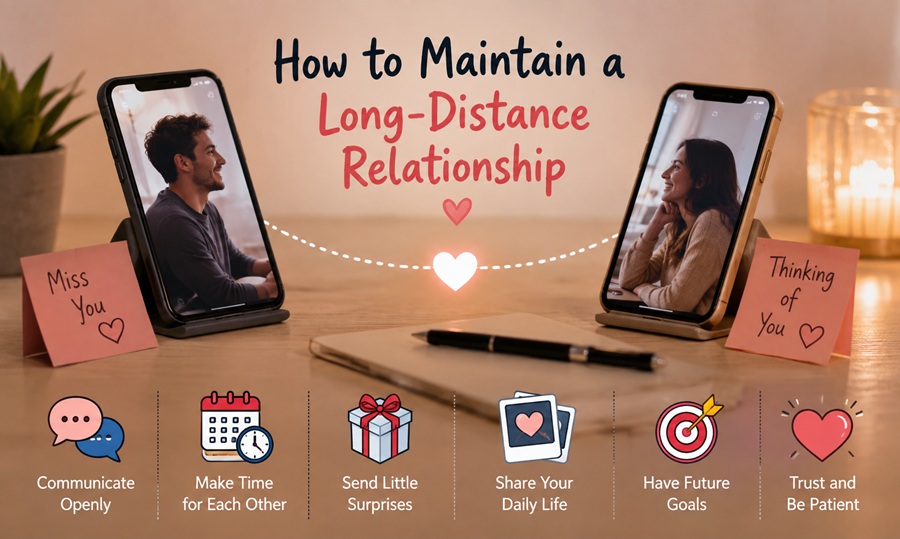
Long-distance relationships hold together best with a predictable communication rhythm, planned visits with an end date in sight, and explicit conversations about trust and expectations upfront. Uncertainty about the future — not distance itself — is usually what strains long-distance couples most.
Distance itself rarely breaks a relationship. What breaks long-distance relationships is usually uncertainty — not knowing when you’ll see each other next, unclear expectations about communication, or an unspoken lack of a plan to eventually close the distance. Here’s a practical approach to managing each of those.
Step 1: Set Clear Expectations Early
Before the distance even starts, talk through specifics rather than assuming you’re aligned: how often you’ll talk, what counts as “checking in,” how you’ll handle time zone differences, and whether the relationship has an end date for the distance itself. Vague assumptions here are one of the most common sources of resentment later.
| TIP
Write down your agreed communication rhythm somewhere both of you can reference it — a shared note works fine. Memory of a verbal agreement tends to drift over months apart. |
Step 2: Build a Communication Rhythm You Can Actually Sustain
Daily texting plus a longer weekly video call tends to work better than sporadic, unpredictable contact — predictability reduces anxiety for both people. That said, match the rhythm to your actual schedules and time zones rather than an idealized version; a rhythm you can’t sustain will eventually feel like a burden instead of a connection.
Step 3: Plan Visits With a Real End Date in Sight
Having the next visit already booked, even months out, gives both people something concrete to look forward to rather than an open-ended stretch of distance. Where possible, also talk openly about the bigger-picture timeline — is this distance temporary for a specific reason (school, work), or open-ended? Couples navigating open-ended distance benefit from revisiting that conversation regularly rather than avoiding it.
Step 4: Handle Jealousy and Trust Directly
Distance amplifies insecurity because there’s less day-to-day reassurance available. Rather than monitoring each other’s social media or demanding constant check-ins, address trust concerns directly and specifically: name the actual behavior that worries you, rather than a vague feeling of unease, and give your partner a chance to respond to something concrete.
| TIP
If jealousy is becoming a recurring theme, it’s worth asking whether it’s about specific behavior or general anxiety about the distance itself — the two need very different responses. |
Step 5: Know When It’s Time to Close the Distance
Long-distance relationships work best as a phase with a horizon, not an indefinite arrangement. If neither partner can articulate a rough timeline or plan for eventually living in the same place, that’s worth an honest conversation — not necessarily to end the relationship, but to make sure both people are working toward the same future.
Signs the Long-Distance Phase Is Working
- Communication feels consistent without feeling obligatory
- Both partners are honest about hard days rather than performing positivity
- Visits are planned in advance rather than arranged last-minute
- There’s a shared, if rough, sense of when the distance will end
Keeping Intimacy Alive Across Distance
Physical distance makes emotional and physical intimacy harder to maintain by default, which is why long-distance couples benefit from being more intentional about it than couples who live together. This can mean scheduled video calls that mimic shared activities — watching the same show simultaneously, cooking the same recipe on a call — or simply protecting some conversations for voice or video rather than defaulting to text, since tone and presence come through far more clearly.
Handling the Emotional Lows
Every long-distance relationship has harder stretches — a missed call, a stressful week apart, a visit that gets cancelled. What separates couples who make it through these moments from those who don’t is usually how they talk about the low points: naming the frustration honestly (“this distance is really wearing on me this week”) rather than either minimizing it or letting it build into resentment neither partner addresses directly.
Financial and Logistical Planning for Visits
Regular visits are expensive, and unclear expectations about who pays for what can quietly become a source of tension. Couples who plan well often set a rough shared visit budget in advance, alternate who travels to reduce the burden on one partner, and build visit costs into their regular financial planning rather than treating each trip as a surprise expense.
The Role of Shared Goals Beyond Just ‘Closing the Distance’
While an end date for the distance itself matters, couples who thrive long-distance also tend to have shared goals that exist independent of geography — career milestones, shared values they’re both working toward, or simply a strong sense of partnership in how they make decisions even while physically apart. Distance is easier to sustain when it feels like a temporary chapter within a larger shared story, rather than the defining feature of the relationship itself.
Supporting Each Other Through Major Decisions From Afar
Big life decisions — job changes, moves, family matters — are harder to navigate long-distance because the day-to-day context that would normally inform a partner’s perspective isn’t as visible. Being deliberate about looping each other into decisions early, rather than only sharing the outcome after the fact, helps both partners feel like active participants in each other’s lives rather than distant observers checking in periodically.
Not every long-distance relationship should continue indefinitely, and it’s worth being honest if the arrangement consistently causes more strain than connection over an extended period, or if one partner is unwilling to work toward eventually closing the distance. Recognizing this isn’t a failure — some relationships are genuinely better suited to a different structure or timing than the one circumstances have placed them in.
Frequently Asked Questions
How often should long-distance couples talk?
There’s no universal number — what matters more is predictability, so both people know what to expect rather than guessing.
Is jealousy normal in a long-distance relationship?
Some increased insecurity is common given less day-to-day reassurance, but persistent jealousy is worth addressing directly rather than ignoring.
How do time zones affect long-distance relationships?
Large time differences require more intentional scheduling for calls, since spontaneous contact becomes harder to sustain.
Should long-distance relationships have an end date?
A rough shared timeline, even an approximate one, tends to sustain motivation better than an open-ended arrangement.
What’s the hardest part of long-distance relationships?
Most couples report uncertainty about the future — not the distance itself — as the most stressful part of the arrangement.
How do long-distance couples maintain intimacy?
Intentional habits like scheduled video calls, shared activities done simultaneously, and prioritizing voice or video over text all help sustain closeness.
How should couples split the cost of visits?
Setting a rough shared visit budget and alternating who travels helps avoid one partner carrying an unequal financial burden.
Long-distance relationships aren’t inherently harder than geographically close ones — they just require more explicit communication about things that proximity usually handles automatically.