
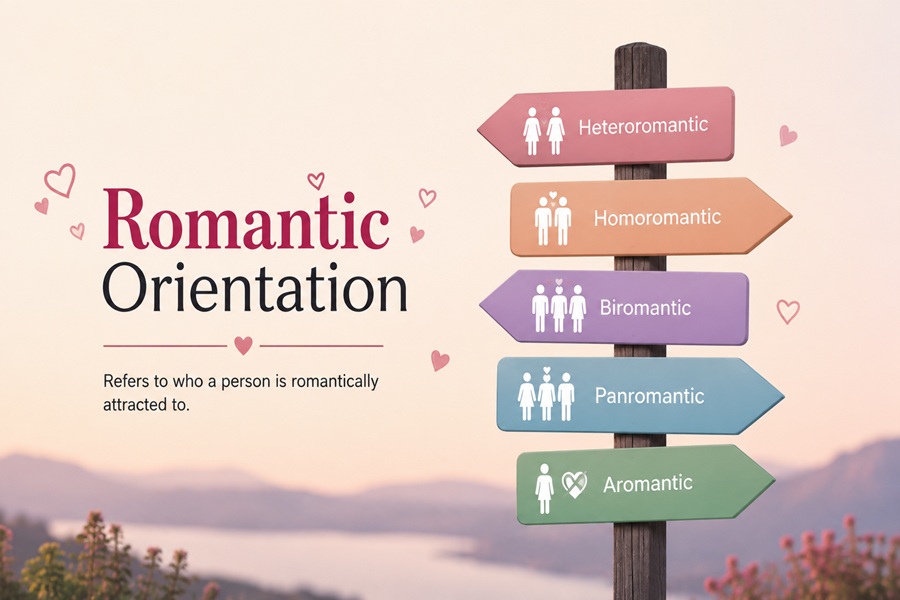
Quick Answer: Romantic orientation describes who a person is romantically drawn to, which can differ from their sexual orientation. Someone might be biromantic and asexual, for example — romantically drawn to multiple genders without corresponding sexual attraction. Recognizing the distinction helps people better understand their own experience of connection.
Sexual orientation gets most of the cultural attention, but romantic orientation — who someone falls for, separate from who they’re sexually attracted to — is its own distinct concept, and understanding the difference clarifies a lot of experiences that don’t fit neatly into more familiar categories.
Romantic vs. Sexual Orientation: The Core Distinction
Sexual orientation describes physical or sexual attraction. Romantic orientation describes the desire for romantic connection — dating, emotional intimacy, partnership — which doesn’t always align with sexual attraction. For most people, the two orientations line up (a heterosexual person is typically also heteroromantic), but for others, they diverge in meaningful ways.
The Romantic Orientation Spectrum
| Term | Meaning |
| Heteroromantic | Romantic attraction to a different gender |
| Homoromantic | Romantic attraction to the same gender |
| Biromantic | Romantic attraction to more than one gender |
| Panromantic | Romantic attraction regardless of gender |
| Aromantic | Little to no romantic attraction to others |
| Demiromantic | Romantic attraction only after a strong emotional bond forms |
| Grayromantic | Romantic attraction that’s infrequent or occurs under specific circumstances |
Why This Distinction Matters
Someone who is asexual but biromantic might still want dating, partnership, and emotional intimacy, just without a sexual component — an experience that’s easy to misunderstand if people assume asexuality means a lack of interest in relationships altogether. Similarly, an aromantic person may still experience sexual attraction and want physical intimacy without romantic attachment. Neither combination is contradictory; they simply reflect that romantic and sexual attraction are separate systems that don’t always move together.
Common Misunderstandings
Aromantic people are sometimes assumed to be incapable of deep connection, which isn’t accurate — many aromantic people form intense, meaningful platonic bonds; they simply don’t experience those bonds through a romantic lens. Similarly, demiromantic and grayromantic identities are sometimes dismissed as “just being cautious,” when they describe a genuinely different pattern of attraction, not a personality trait or a matter of pace.
How to Figure Out Your Own Romantic Orientation
There’s no test that provides a definitive answer — most people arrive at clarity by noticing patterns over time: whether romantic attraction shows up independent of sexual attraction, whether it requires an emotional bond first, or whether it’s largely absent regardless of connection. Language exists to describe a pattern you’ve already noticed, not to create the pattern itself.
The Split Attraction Model
The framework separating romantic and sexual orientation is sometimes called the split attraction model. It’s a useful lens for understanding experiences that don’t fit a single-orientation description, though it’s worth noting not everyone finds it necessary or personally relevant — some people are comfortable using a single term to describe both their romantic and sexual attraction, especially when the two align closely, while others find the added precision genuinely clarifying.
Romantic Orientation and Relationship Structures
Understanding romantic orientation has practical implications for how people build relationships. An aromantic person, for example, might prioritize a deep, committed friendship (sometimes called a queerplatonic relationship) over a traditionally romantic partnership, while still wanting the same level of commitment, shared living, or long-term planning associated with romance. Recognizing romantic orientation as distinct from sexual orientation has helped create more language and social recognition for these relationship structures, which don’t fit neatly into either “just friends” or “romantic partners.”
Talking to Partners About Romantic Orientation
If your romantic orientation differs from what a partner expects or assumes, direct conversation early on prevents a lot of confusion later. Someone who is demiromantic, for instance, might need to explain that a slower-building attraction isn’t a lack of interest, just a different timeline — a distinction that matters a lot to a partner who might otherwise misread the pace as disinterest.
Romantic Orientation Across Different Life Stages
For many people, romantic orientation feels stable and clear from a fairly young age. For others, it becomes clearer only after specific experiences — a relationship that felt hollow despite genuine care, or an unexpectedly strong connection that didn’t fit prior assumptions. Neither path is more valid than the other; some people arrive at self-understanding early through introspection, while others need lived experience to recognize a pattern that wasn’t obvious in the abstract.
Supporting a Partner Who Identifies Differently Than You Expected
If a partner shares that their romantic orientation differs from your assumptions — for instance, discovering they’re demiromantic partway into a relationship — the most supportive response is curiosity rather than defensiveness. Asking what that means for how they experience the relationship, rather than treating it as a problem to be solved, keeps the conversation focused on understanding rather than reassurance-seeking on your own behalf.
The aromantic spectrum itself contains meaningful variation beyond a simple present-or-absent framing. Some aromantic people experience no romantic attraction at all under any circumstances, while others on the spectrum — sometimes called grayromantic or demiromantic — experience it rarely, faintly, or only under specific conditions. This spectrum mirrors how sexual orientation is understood as a range rather than a strict binary, and the same nuance applies equally well to romantic orientation.
Why Language for Romantic Orientation Has Grown in Recent Years
Terms like aromantic, demiromantic, and queerplatonic have gained wider use largely because online communities gave people a place to compare experiences and realize their pattern of attraction had a name, even if mainstream culture hadn’t caught up yet. This growing vocabulary hasn’t created new experiences — it’s given existing, previously unnamed experiences a shared language, which for many people has been meaningfully validating after years of feeling like an outlier without knowing why.
Frequently Asked Questions
Can someone be aromantic and still want a long-term partner?
Yes — some aromantic people pursue committed partnerships built on companionship rather than romantic attraction.
Is romantic orientation the same as sexual orientation?
No — they’re related but distinct; a person’s romantic and sexual attractions can point in different directions.
What does demiromantic mean in simple terms?
It describes romantic attraction that only develops after a strong emotional connection has already formed, rather than from initial impressions.
Is it common for romantic and sexual orientation to differ?
It’s less common than alignment between the two, but well-documented enough to have its own established terminology.
How do I know if I’m aromantic?
Noticing a consistent lack of desire for romantic (as opposed to platonic or sexual) connection over time is typically the clearest indicator.
What is a queerplatonic relationship?
It’s a committed relationship that isn’t romantic but involves a similar level of closeness, commitment, or shared life planning as a romantic partnership.
Do I need to use split attraction language if it doesn’t feel necessary to me?
No — the framework is a tool for people who find it clarifying, not a requirement for everyone to describe their attraction this way.
Romantic orientation gives language to an experience many people have but rarely have words for — and having that language often makes it easier to understand your own relationships, and to explain them to the people in your life.