
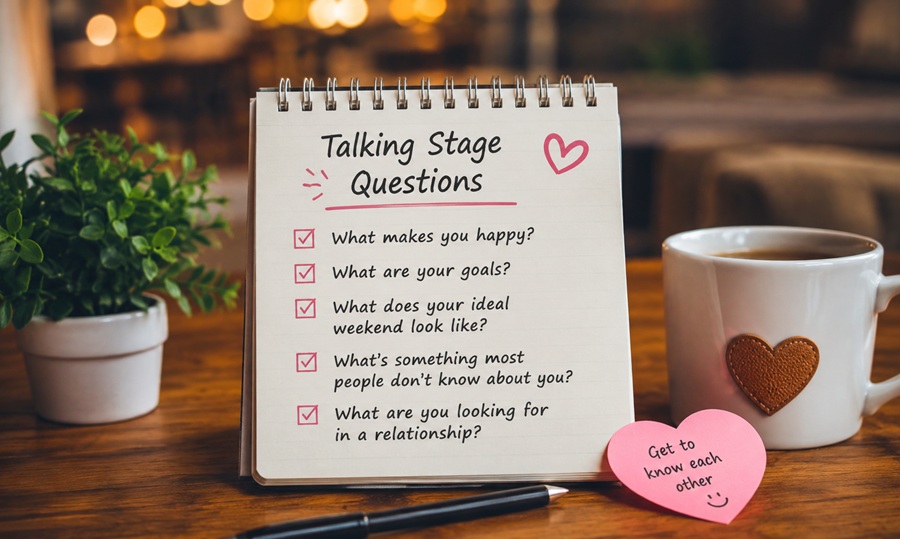
| QUICK ANSWER
The talking stage is the exploratory period before two people define a relationship. The right questions during this phase help you gauge compatibility, communication style, and intentions without the pressure of labels — saving time and emotional energy on the wrong match. |
What Counts as a ‘Good’ Talking Stage Question?
Not every question moves things forward. A good talking stage question does three things: it invites a real answer instead of a one-word reply, it reveals something about values or lifestyle rather than trivia, and it feels natural in the conversation instead of like an interview. The goal isn’t to interrogate someone — it’s to build a picture of who they are while they build one of you.
Timing matters too. Asking about future kids on day two will feel jarring, while asking it after three weeks of consistent texting is reasonable. Use the checklist below to match your questions to where you actually are in the process.
Checklist: Icebreaker-Level Questions (Week 1)
- What’s taking up most of your headspace this week?
- What’s a small thing that made you happy recently?
- Coffee, tea, or neither — and how do you take it?
- What does a perfect Saturday look like for you?
- What show or podcast are you currently obsessed with?
- Are you more of a planner or a ‘figure it out as we go’ person?
- What’s something you’re weirdly good at?
Checklist: Compatibility Questions (Week 2–3)
- How do you usually handle stress?
- What does your ideal weekend with a partner look like?
- Are you close with your family, and what does that look like?
- What’s a dealbreaker for you in dating?
- How do you like to be shown you’re appreciated?
- What’s something you’re working on improving about yourself?
- Do you see yourself staying in this city long-term?
Checklist: Intention-Clarifying Questions (Week 4+)
- What are you looking for right now — something casual or something serious?
- How do you feel about where this is heading?
- What made you want to keep talking to me after the first date?
- How do you typically know when you’re ready to be exclusive?
- What’s something that would make you pull back from someone you’re into?
Questions That Read the Room Before You Ask Them
Before firing off a deep question, check the temperature of the conversation. If replies are short and slow, it’s not the moment for ‘what are we.’ If someone is initiating plans and asking you questions back, that’s your green light to go deeper. Reciprocity is the real signal — if you’re the only one asking thoughtful questions, that imbalance is information too.
Frequently Asked Questions
Q: How long should the talking stage last?
There’s no fixed timeline, but most people move toward clarity within four to eight weeks. If it drags on for months with no progress toward exclusivity or a defined relationship, that’s often a sign the other person is content with ambiguity.
Q: Is it too early to ask about exclusivity?
It depends on frequency of contact, not calendar days. If you’re talking daily and seeing each other weekly, asking after three or four weeks is reasonable. If contact is sporadic, wait until a consistent pattern forms.
Q: What if they give short answers to deep questions?
Short answers to genuine questions can mean disinterest, discomfort with vulnerability, or just a naturally reserved communication style. Watch the pattern across several conversations rather than judging one exchange.
Q: Should I ask about past relationships during the talking stage?
Light context is fine, but a full history isn’t necessary this early. Ask what they learned from past relationships rather than asking for details about exes.
Q: Can too many questions kill the momentum?
Yes. Alternate questions with sharing your own answers and reactions. A talking stage should feel like a conversation, not a survey.
The talking stage exists to protect your time. Use it deliberately. A handful of well-placed questions will tell you more about compatibility than weeks of surface-level texting ever could, and they’ll help both people move toward clarity instead of drifting in limbo.